Today I woke up feeling different. Happier than usual.
And the reason is simple, yet profound: a coral restoration system that also acts as coastal protection is now fully installed and operating in the bay where I live. A dream that once felt impossible has finally become reality.
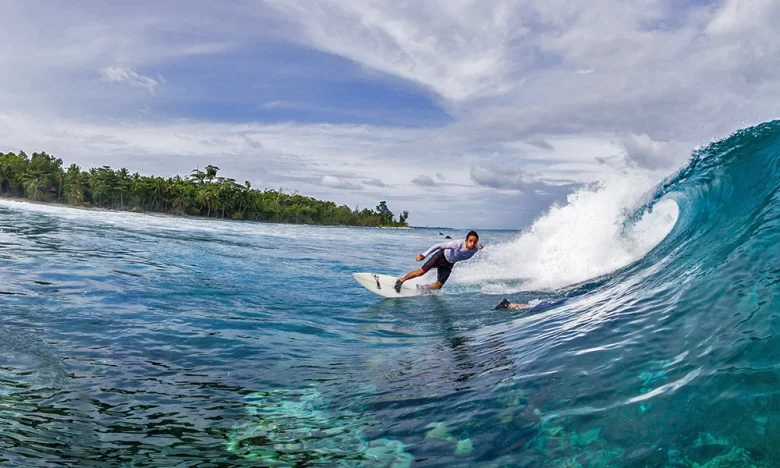
I have been living on one of the islands of the Mentawai archipelago since 2013, when I began building a surf resort in one of the most remote regions of Indonesia.
The year before, after many years of hard work and a routine that kept me far from the ocean and free time, I finally found the courage to walk away from it all. I left behind everything a “normal” life is supposed to offer in exchange for a simpler existence in the middle of nowhere, surrounded by what I love most: perfect waves and untouched nature.
Very quickly, I learned how difficult it is to build anything in such a remote location.
Missing a single screw? You had to wait for the next boat from Padang, which only crossed twice a week, weather permitting. On top of that came the challenge of learning a new language, adapting to a different culture, and overcoming countless logistical obstacles.
But the greatest lesson of all came from understanding the power of nature.
During several extreme weather events, the ocean showed its true strength. Waves advanced relentlessly, eating away at the beach year after year, bringing the shoreline closer and closer to our buildings. Months of work and care could be erased in just a few hours.
The only solution was to rebuild, again and again, and try to understand the natural movements of the sea.
In May 2020, a powerful swell combined with extreme tides truly scared us. The force of the waves invaded our two main bungalows, and after days of constant impact, one of them collapsed. This happened just as the COVID-19 pandemic began, leaving me deeply concerned about the future.
That’s when I started searching for solutions online. I found several effective coastal protection systems, but their costs were far beyond what we could afford.
During this research, I came across a YouTube video showing the work of Biorock Indonesia on Gangga Island in North Sulawesi.
Stone-filled gabions formed the base for steel structures connected to a low-voltage electrical system, which causes calcium carbonate to bond to the metal. This process not only reduces wave energy but also transforms the structures into thriving coral gardens, with coral growth rates up to six times faster than natural reefs.
I was already familiar with Biorock’s coral restoration work, but I had never realized its potential as a coastal erosion protection system. In addition to restoring coral reefs, the mineral accretion process makes the metal structures progressively stronger and heavier. It was the perfect solution for creating natural wave barriers.
By December 2020, after an entire year without guests, I noticed something alarming. Tides during full and new moons were unusually high. It truly felt as if sea levels were rising. The ocean continued to advance.
I decided to build a small breakwater next to one bungalow that was clearly destined to be swallowed by the sea. It worked.
However, erosion in front of the restaurant worsened significantly, filling the lagoon with sand for the second time. I had already excavated it once before, after another massive tide back in 2017.
With no guests at the resort, I decided to use the time to properly learn about the Biorock method. I contacted the Gili Eco Trust, a foundation that has installed and maintains more than 150 Biorock coral structures in the Gili Islands, in partnership with Biorock Indonesia.
They supported the idea, but recommended that I first complete two levels of PADI scuba diving certification. This meant five days learning to dive, followed by additional training focused on coral health monitoring and Biorock system data collection.
In the very first days, something magical happened. I became completely addicted to exploring the underwater world. I learned how fragile the marine ecosystem truly is, and how this delicate balance is constantly being disrupted by human activity.
The Gili Islands are a true turtle sanctuary, and diving there opened my eyes to marine life in a profound way. It also marked a major shift in my environmental awareness.
During my dive training, I met Delphine, a passionate and tireless French environmentalist working on the island. Beyond coral restoration, the Gili Eco Trust is deeply involved in waste management, animal welfare, and environmental education.
Delphine organizes the island’s waste processing system, separates and recycles materials, cares for horses and cats, and leads educational projects such as weekly beach cleanups and school programs. I quickly became a huge admirer of her work. Through this connection, I also met her eight-year-old son, Ewan, who was receiving almost entirely outdoor, island-based education during the pandemic.
Each day, I dreamed more about bringing this entire concept to the islands surrounding my home. And then, incredibly, Delphine became interested in joining the project.
Total madness, in the best way possible.
I returned home determined to move forward. It was a difficult decision. Our financial resources were nearly exhausted, and we had no idea when guests would return. But I took the leap. My partners agreed, and we began developing the project with Delphine’s support and the arrival of Tassya Karissa, President of Biorock Indonesia.
Ideally, we wanted to install around 25 Biorock systems, but budget constraints limited us to 13 structures, along with a new breakwater positioned exactly where beach erosion typically stops.
Delphine and Tassya worked tirelessly to reduce costs. For weeks, I sourced materials at the best possible prices, mostly from Java, while organizing the complex logistics of bringing the team to Siberut Island in the Mentawai Islands.
Finally, on March 27, 2021, Delphine arrived in Siberut with her son Ewan and Pak Paulus, another Biorock Indonesia specialist who had also worked on the Gangga Island project.
On the first day, work began immediately. We closed part of the gabions while a local team handled welding. Delphine and Pak Paulus measured and designed the system layout. I could hardly believe it was actually happening.
On day two, we placed the first gabions in the water. That part was easy. Filling them was not. Each system required about four cubic meters of stone, but heavy rocks simply don’t exist on these islands. The solution involved collecting construction debris, old machinery parts, stones from the opposite side of the bay, and even producing concrete blocks locally. It was chaotic and exhausting, and the work continued for more than seven days.
By the third day, Delphine began installing the electrical components. We built a small structure to house the inverters powering the system. As she prepared the cables, we installed steel meshes over the gabions. Slowly, the systems began taking shape.
A few days later, the first group of four Biorock structures was activated. Soon after, eight were fully operational, with five more still under construction.
On the seventh day, all 13 Biorock systems were completed and running. We could already see the metal turning white, a clear sign that electrolysis and mineral accretion were working perfectly. Tiny bubbles from the chemical reaction were visible underwater.
With the system fully installed, Pak Paulus conducted beach measurements while Delphine completed the coral health survey.
We even had time for a final dive together, watching a beautiful wave break nearby. They confirmed that life still existed on the reef formations and that this project would play a vital role in protecting these marine sanctuaries in the Mentawai Islands.
One week later, we arrive at today, where this story began.
Now it’s my responsibility to continue the work. I transplant loose coral fragments, remove algae and sponges that inhibit coral growth, not only from the Biorock structures but gradually throughout the entire bay.
The beach already looks different. It truly seems like the system is working. Time will tell, but one thing is certain: more corals now have a chance to grow, and with them, more marine life will thrive.
It may feel like a small bird carrying drops of water to fight a forest fire. But perhaps you, too, can join in, in your own way, doing what you can, however you can, with the shared goal of creating a healthier planet and a better place to live.
By Alexandre Ribas